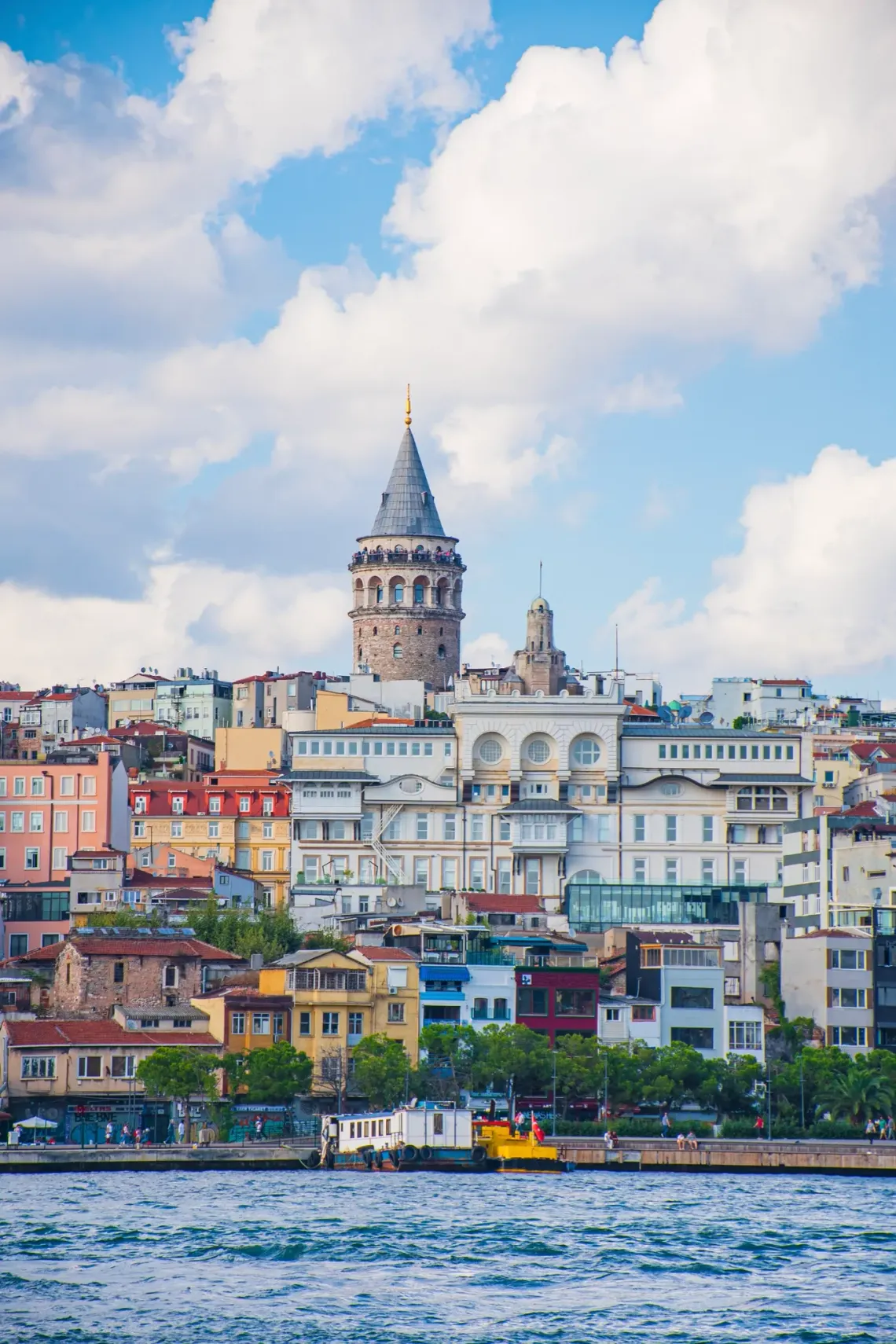
The Sentinel of the Golden Horn: A Definitive Historical and Cultural Analysis of the Galata Tower
Executive Summary: The Palimpsest of Pera
The Galata Tower, piercing the skyline of Istanbul for nearly seven centuries, is far more than a mere tourist observation deck or a relic of Genoese fortifications. It is a vertical palimpsest—a stone manuscript upon which the history of an empire, a colony, and a republic has been overwritten time and again. To understand the Galata Tower is to understand the geopolitical shifts of the Mediterranean, the scientific awakening of the Ottoman East, the urban traumas of fire and earthquake, and the romanticized gaze of the West upon the Orient.
This comprehensive report, commissioned for the historical archives of Galatatower.com, moves beyond the superficial facts commonly found in guidebooks. It excavates the structural, social, and political layers of the tower, distinguishing the Megalos Pyrgos of the Byzantines from the Christea Turris of the Latins, and tracing its evolution from a Catholic stronghold to an Islamic astronomical observatory, a fire watchtower, and finally, a secular museum. Through an exhaustive analysis of primary sources, archaeological reports from the 2020 restoration, and the accounts of travelers like Evliya Çelebi and Edmondo De Amicis, this document provides an unparalleled resource for understanding the "Sentinel of the Golden Horn."
Chapter 1: The Myth of the First Tower and the Great Chain
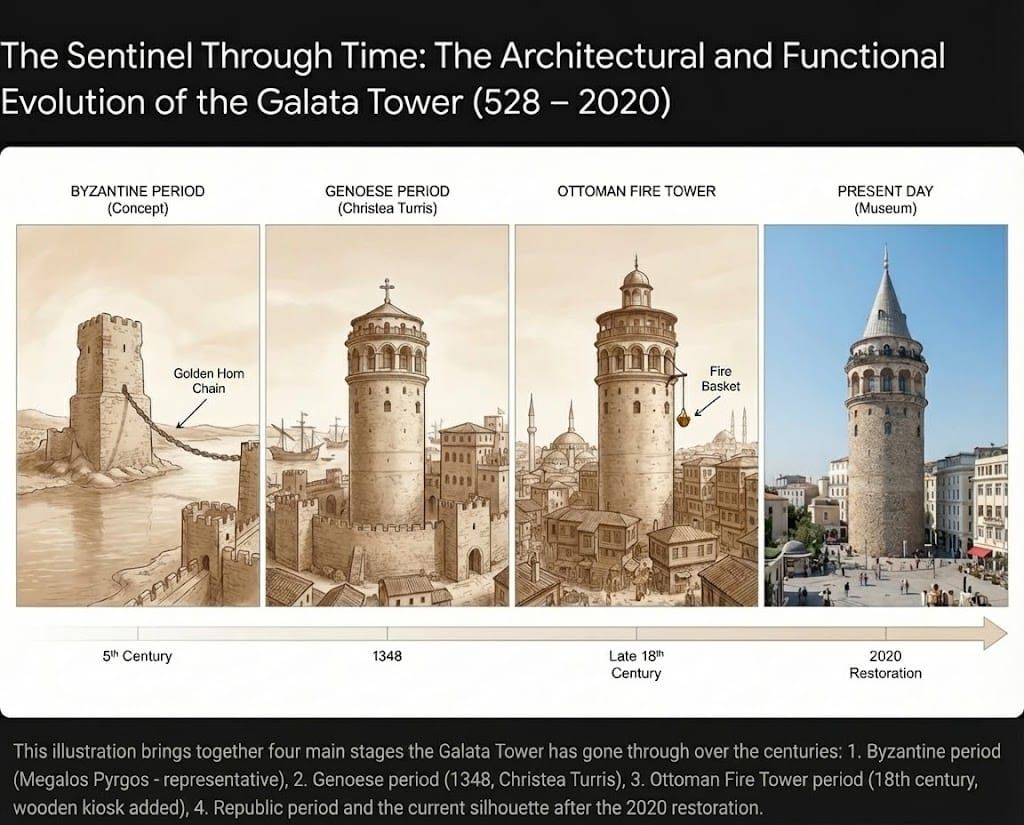
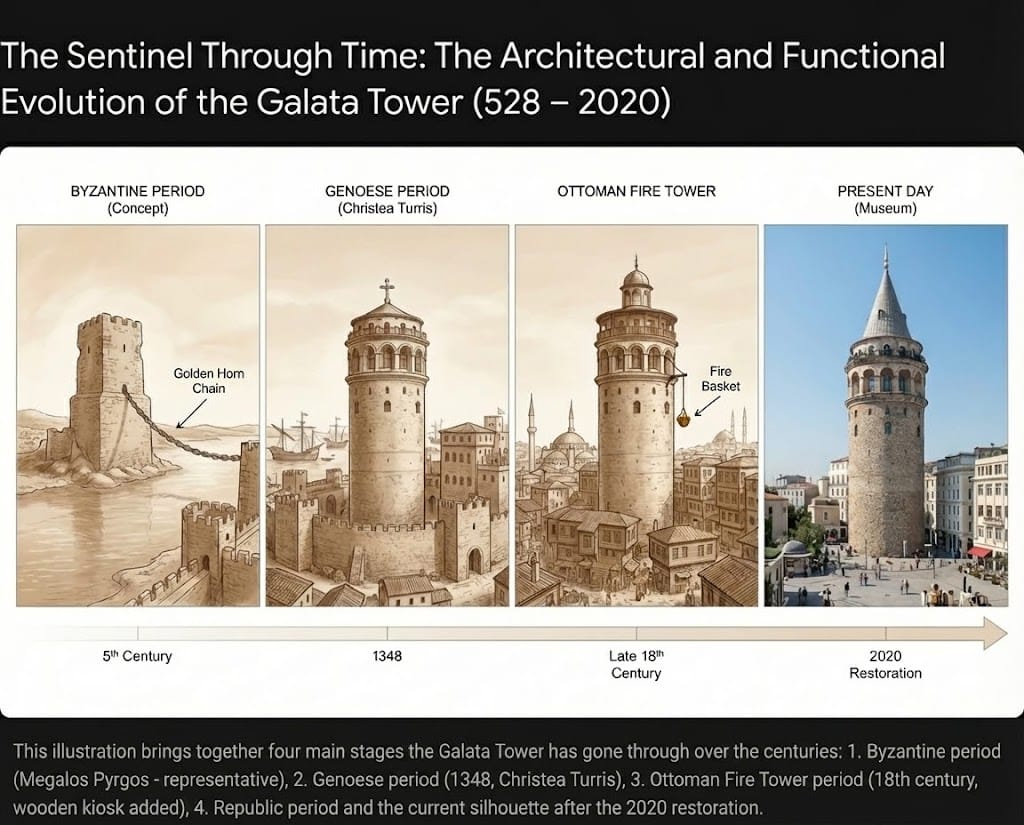
1.1 The Confusion of Identity: Megalos Pyrgos vs. Christea Turris
One of the most persistent misconceptions in popular tourism is the conflation of the current Galata Tower with the Byzantine "Great Tower" (Megalos Pyrgos). It is imperative for the historical integrity of Galatatower.com to clarify this distinction, as it reveals the shifting strategic geography of Constantinople.
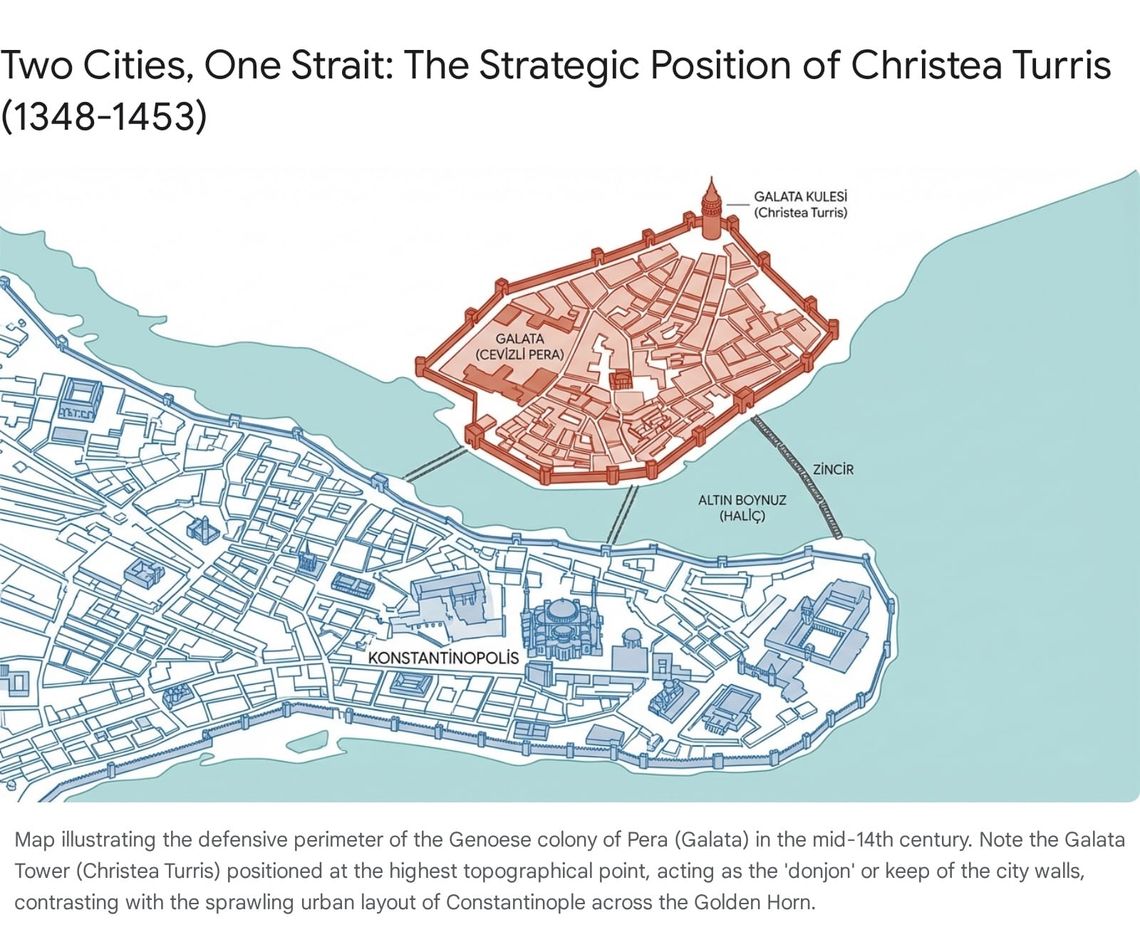
The story begins not on the hill of Galata, where the current tower stands, but closer to the shoreline. In the 6th century, likely around 507 CE or 528 CE during the reign of Emperor Justinian, the Byzantines erected a massive defensive structure. This original tower was a military bastion, explicitly designed to control the northern anchor of the famous Golden Horn Chain (Haliç Zinciri). This chain was a colossal iron barrier that could be winched across the mouth of the estuary to Seraglio Point (Sarayburnu), physically blocking enemy ships from attacking the city's vulnerable harbor.
This Byzantine tower was known as the Megalos Pyrgos (Great Tower). However, it was not located at the apex of the hill (the current site). It stood at the water's edge, in the area now occupied by the Yeraltı Camii (Underground Mosque) in Karaköy. This structure was effectively a kastellion (fortress). Historical records indicate that this original tower was destroyed, or significantly dismantled, by the Latin Crusaders during the catastrophic Fourth Crusade and the Sack of Constantinople in 1204. The destruction of the Megalos Pyrgos symbolized the collapse of Byzantine naval supremacy.
The tower we see today is a different entity entirely. It was constructed nearly a century and a half later, in 1348, by the Genoese. The Genoese, a maritime republic from Italy, had established a semi-autonomous trading colony in Galata (Pera). As their power and wealth grew, they sought to fortify their colony against both the Byzantines (their nominal overlords) and potential invaders. They built a new citadel walls system, and at the highest point of these walls—the vertex of the cone of Galata—they erected the Christea Turris (Tower of Christ). This distinction is crucial: the Byzantine tower was a naval lock; the Genoese tower was a hilltop sentinel and a declaration of religious and political autonomy, crowned not just with battlements but with the symbolism of Christ in a largely Orthodox (and later Islamic) geography.
1.2 The Strategic Function of the Genoese Citadel
The construction of the Christea Turris in 1348 was a provocative act. The Treaty of Nymphaeum (1261) and subsequent agreements had granted the Genoese trading privileges, but expanding fortifications was often a point of contention with the Byzantine emperors. The tower served as the donjon (keep) of the Genoese fortifications. It was the ultimate fallback point, the highest lookout, and the visual marker of Genoese territory.
From its parapets, Genoese sentries could observe traffic entering the Bosphorus from the Black Sea—critical for their trade dominance—and monitor the Golden Horn. The tower was designed in the Romanesque style, reflecting the architectural heritage of Italy rather than the East. Its walls were massive, over 3.75 meters thick at the base, built of rubble stone mesh, ensuring it could withstand medieval siege engines.
1.3 The Fate of the Great Chain
The connection between the Galata Tower and the famous chain of the Golden Horn is often misunderstood. While the Megalos Pyrgos physically held the chain, the Christea Turris (the current tower) did not. However, the chain itself remains a potent symbol of the area's history. Following the Ottoman conquest in 1453, parts of this legendary chain were preserved. Today, segments of the chain are exhibited in the Istanbul Archaeological Museums and the Istanbul Maritime Museum. The chain was a marvel of medieval engineering, consisting of massive iron links designed to float on wooden logs, creating an impassable barrier for naval vessels. Its failure to stop Mehmed II—who famously transported his ships over land to bypass it—marked the end of the Byzantine defensive strategy that relied on the Megalos Pyrgos and the chain.
Chapter 2: The Ottoman Conquest and the Transfer of Keys
2.1 The Surrender of 1453
When Sultan Mehmed II (Fatih) conquered Constantinople on May 29, 1453, the status of Galata hung in the balance. The Genoese had maintained a precarious neutrality during the siege, though clandestine aid had flowed to the Byzantines. Recognizing the inevitable shift in power, the Genoese podestà surrendered the keys of the colony to the Sultan on the very morning of the conquest.
This event is memorialized in the marble inscription found at the entrance of the tower today. The inscription serves as a primary document of transition, marking the moment Galata ceased to be an Italian colonial outpost and became an Ottoman district. Crucially, while Mehmed II ordered the demolition of the land walls of Galata to prevent the colony from ever defying him militarily, he spared the Galata Tower itself, recognizing its utility as a watchtower and a symbol of dominion. The tower was shortened—the top section was modified—but the structure survived.
2.2 The Tower as a Dungeon: The "Tower of Blood"
In the 16th century, particularly during the reign of Suleiman the Magnificent (1520–1566), the function of the tower darkened. It was converted into a dungeon (prison), specifically serving the Kasımpaşa Naval Dockyard (Tersane-i Amire).
This era introduces a "Gothic" element to the tower's history that is often overlooked in light, touristic narratives. The prisoners held here were often galley slaves, prisoners of war, or high-profile foreign captives. The proximity to the dockyards meant that the tower was an integral part of the Ottoman naval machine; labor was extracted from the dungeon to power the Sultan's fleets. Recent archaeological work in 2020 has unearthed skeletal remains in the tower's foundations, which forensic analysis suggests may belong to convicts who died attempting to dig escape tunnels or simply perished in the harsh conditions of the "Tower of Blood".
One of the most intriguing historical footnotes from this period is the imprisonment of foreign diplomats and spies. The French diplomat and scientist Pierre-Joseph de Beauchamp was imprisoned in the Ottoman territories during Napoleon's campaign in Egypt (1798-1801). While some sources place him in the Yedikule Fortress or Rumeli Hisarı, local legends and some historical conflations suggest the Galata Tower also served as a holding site for "Frankish" prisoners of note, or at least as part of the network of incarceration for foreign agents. This connects the tower directly to the Napoleonic Wars and the global geopolitical chess game of the 19th century.
2.3 The "Frankish" City
The tower stood in Pera (Beyoğlu), the "Frankish" or European quarter. Unlike the "Turkish" Istanbul across the Horn, Galata was a cosmopolitan mix of Italians, Greeks, Jews, French, and Armenians. The tower was the anchor of this multicultural enclave. To climb it was to rise above the segregation of the neighborhoods and see the city as a unified, albeit complex, whole. The Venetians also had a presence here; the Bailo (Venetian ambassador) was a key figure in Galata's diplomatic life. Although the Venetian palace was a separate structure, the tower loomed over the entire district where these diplomatic intrigues played out.
Chapter 3: The Golden Age of Islamic Astronomy and the Lost Observatory
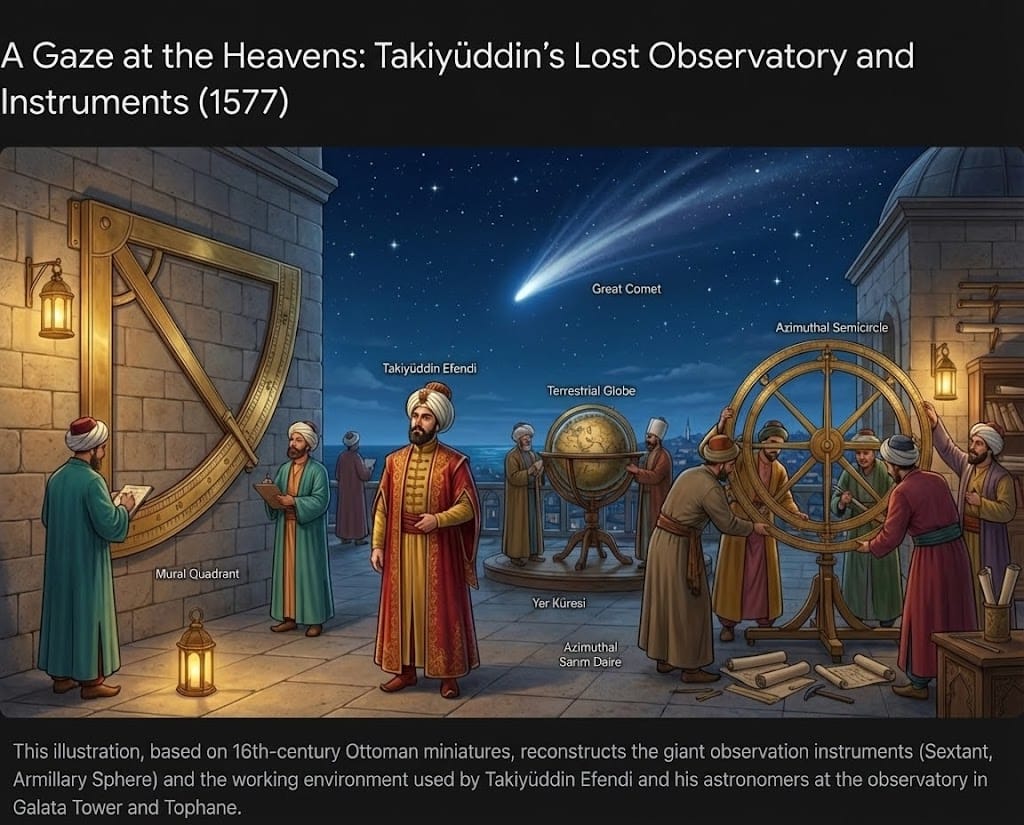
3.1 Takiyüddin’s Observatory (1574-1580)
Perhaps the most intellectually significant period in the tower's history is its brief tenure as a hub of scientific observation. In the late 16th century, the Ottoman chief astronomer Takiyüddin Efendi (Taqi ad-Din Muhammad ibn Ma'ruf) established an observatory in Istanbul.
There is a scholarly debate regarding the exact location. While the main, purpose-built observatory (Dar al-Rasid al-Jadid) was constructed on the ridge above Tophane (near the present-day French Palace), historical records and miniatures confirm that Takiyüddin utilized the Galata Tower for his initial observations and calculations while the main facility was being built. He also established a library of astronomy within the tower.
3.2 The Comet and the Destruction
The scientific potential of the Galata Tower was cut short by religious and political reactionism. In 1577, a great comet appeared in the sky. Takiyüddin interpreted this as a harbinger of Ottoman victory against the Safavid Persians. However, a subsequent plague and political infighting led the Sheikh al-Islam (chief religious authority) to petition Sultan Murad III, arguing that "prying into the secrets of the heavens brings misfortune".
Consequently, in a tragic act of anti-intellectualism, the Sultan ordered the destruction of the observatory in 1580. Instruments that rivaled those of Tycho Brahe in Europe were dismantled. The Galata Tower lost its role as a beacon of science and reverted to a prison and storage facility. This episode is a pivotal "what if" moment in Ottoman history—had the work at Galata and Tophane continued, the trajectory of Ottoman science might have paralleled the Scientific Revolution in Europe.
Chapter 4: The Legend of Wings – Hezarfen Ahmed Çelebi
4.1 The Event: A Transcontinental Flight?
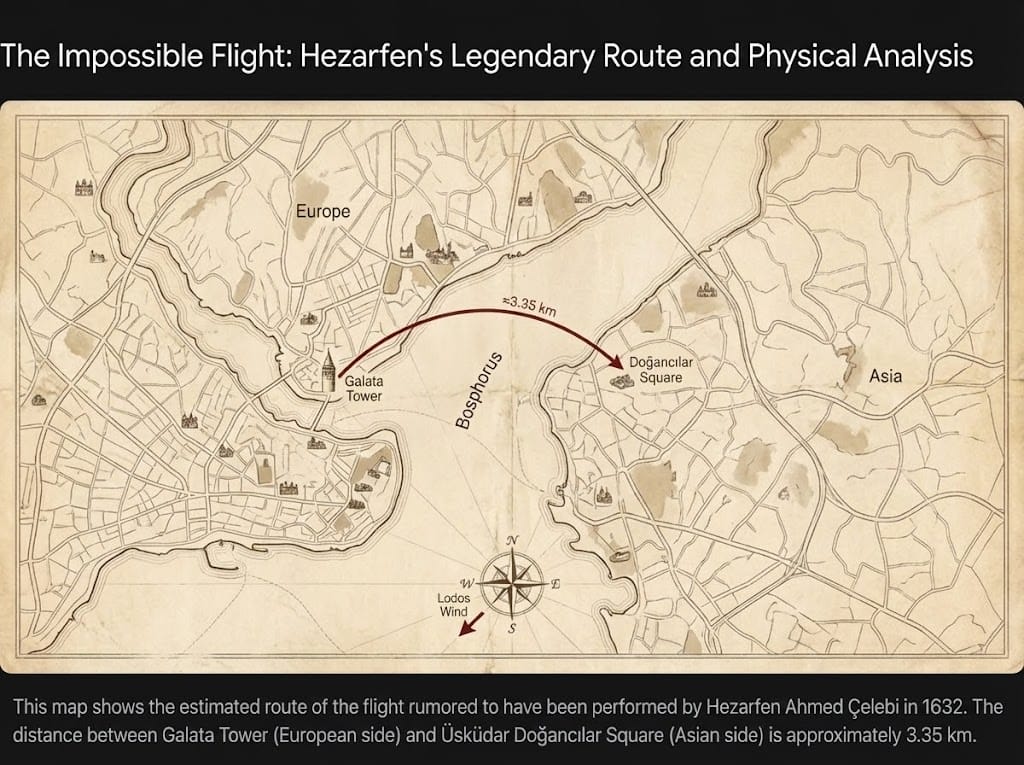
The most famous legend associated with the Galata Tower is undoubtedly the flight of Hezarfen Ahmed Çelebi in 1638. According to the traveler Evliya Çelebi (the sole source for this event), Hezarfen fashioned a pair of eagle-like wings and launched himself from the apex of the tower.
The narrative claims he flew across the Bosphorus, aided by the southwest wind (lodos), and landed successfully in Doğancılar Square in Üsküdar, on the Asian side—a distance of approximately 3.3 kilometers. Sultan Murad IV, watching from the Sinan Pasha Mansion at Sarayburnu, was initially impressed and rewarded Hezarfen with a sack of gold. However, fearing a man with such "uncanny" abilities, he subsequently exiled him to Algeria, where Hezarfen died.
4.2 Scientific Feasibility and Modern Analysis
For a modern "informational" website, it is crucial to analyze this myth through the lens of physics. Modern aerodynamic studies suggest that a pure glide from the top of the Galata Tower (approx. 63m high + 35m hill elevation = ~100m total elevation) to Üsküdar is aerodynamically impossible with simple artificial wings due to the glide ratio required.
To bridge the Bosphorus, Hezarfen would have needed a glide ratio far exceeding that of modern hang gliders, or he would have needed to catch significant thermal updrafts. While Evliya Çelebi is known for his exaggerations (often blending fact with folklore), the story resonates as a symbol of Ottoman ambition and curiosity. It represents the "Icarus" archetype but with a successful landing, only to be crushed by political fear. This dichotomy—scientific bravery vs. authoritarian caution—is a recurring theme in the tower's history.
Chapter 5: The Fire Watchtower Era (1717-1960s)
5.1 The Scourge of Fire
Istanbul, a city historically built of timber, lived in constant fear of fire. The Galata Tower, with its commanding view of the Historic Peninsula and Beyoğlu, became the city's primary defense against this threat in the 18th century. In 1717, under the Ottomans, the tower was formally designated as a Fire Watchtower (Yangın Kulesi).
A dedicated corps of watchmen resided in the upper levels. Their duty was to scan the horizon 24 hours a day. When smoke was spotted, they would signal the location to the fire brigades (tulumbacılar) and the erratic water carriers.
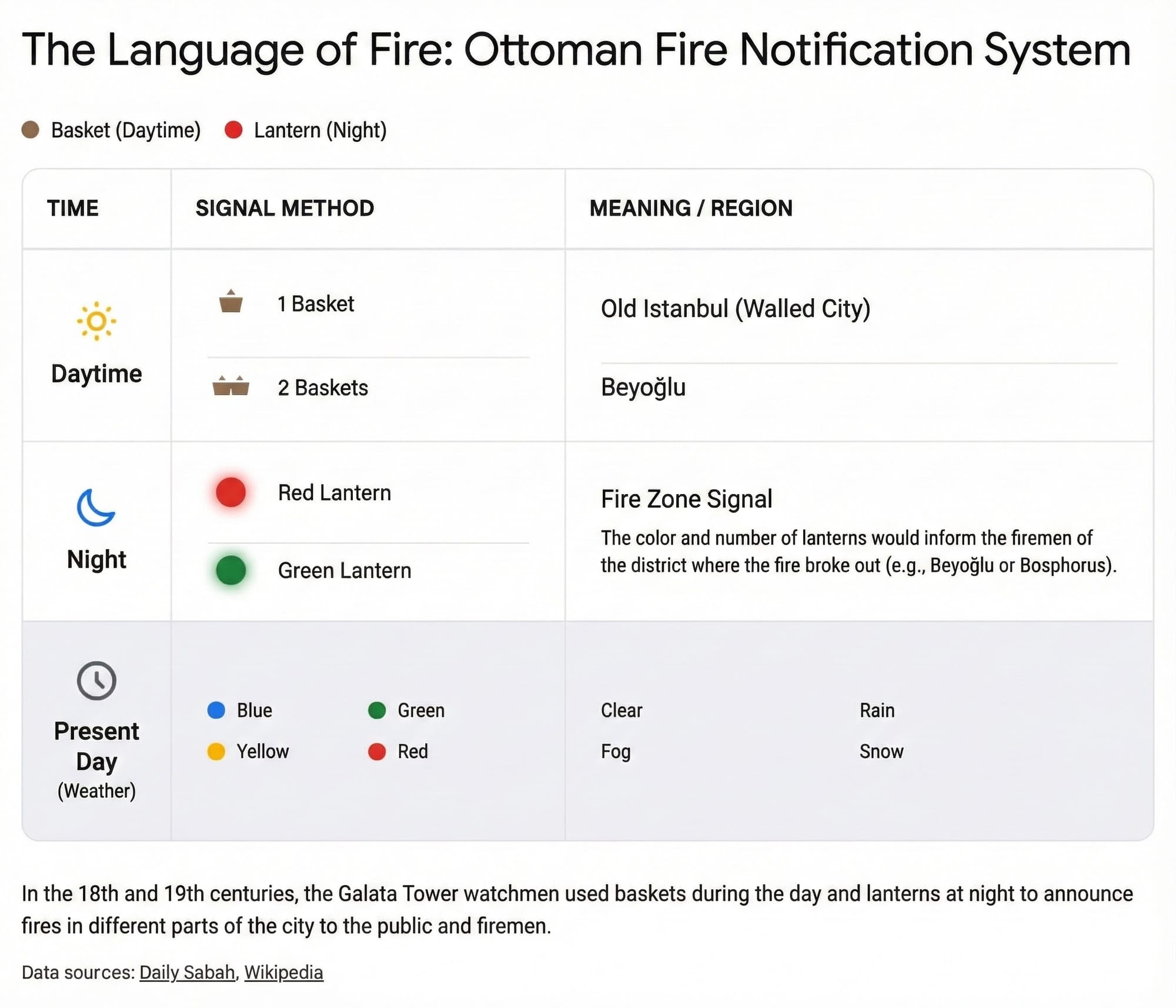
5.2 The Language of Baskets and Flags
The tower developed a unique visual language to communicate with the city, a detail that adds rich "local color" to the report.
- Daytime: Large baskets were hung from the tower's poles to indicate a fire.
- Nighttime: Large colored lanterns were used.
This signaling system was later refined into a color-coded flag/light system that is still referenced in the tower's modern lighting:
- Red: Fire in Istanbul (Stambul/Old City).
- Green: Fire in Beyoğlu.
- White/Blue: Fire in Anatolia (Üsküdar/Kadıköy).
(Note: Some sources vary on the exact color coding over the centuries, but the principle of directional signaling remained constant ).
Ironically, the Fire Tower itself was not immune. It was famously damaged by fires in 1794 (repaired by Selim III) and 1831 (repaired by Mahmud II). The 1831 restoration is particularly significant because it gave the tower the iconic conical roof shape we recognize today, designed by the architect Hayreddin (though earlier restorations are also attributed to names like Murad bin Hayreddin). Correction: The 1831 restoration gave it a conical roof, but a storm in 1875 destroyed this roof, leaving the tower with a flat top for much of the late Ottoman and early Republican periods until the 1967 restoration brought the cone back.
Chapter 6: Architectural Metamorphosis and Restoration
6.1 The 19th Century: From Cone to Flat Top
The silhouette of Galata Tower has not been static. Following the fire of 1831, Sultan Mahmud II commissioned a restoration that added a conical roof. However, a fierce storm in 1875 blew this roof off. For almost a century—spanning the end of the Empire and the first decades of the Republic—the tower stood "headless," capped by a flat timber deck with a small polygonal shelter for watchmen. This is the version of the tower seen in many late 19th-century photographs and described by writers like Hemingway.
6.2 The 1967 Reconstruction: Concrete vs. History
In the 1960s, a major restoration was undertaken by the architect Köksal Anadol. This was a radical intervention. The wooden interior, which was rotting and dangerous, was completely gutted. It was replaced with a reinforced concrete core, and elevators were installed for the first time. While this ensured the tower's survival and accessibility for tourism, purists argue it stripped the tower of its internal historical authenticity. It was during this restoration that the iconic conical roof was reconstructed, restoring the tower to its early 19th-century silhouette.
6.3 The 2020 Restoration: Archaeology and Controversy
The most recent chapter in the tower's physical history occurred in 2020, when control was transferred to the Ministry of Culture and Tourism. This restoration aimed to remove the "accretions" of the 1960s—specifically the cafeteria and restaurant on the top floors—to convert the entire structure into a museum.
This project was marred by controversy when footage emerged of workers using jackhammers on the historic walls, sparking a national outcry. However, the restoration also yielded significant archaeological finds. Skeletons were discovered in the basement levels, confirming the tower's grim history as a dungeon and potential execution site. The removal of the restaurant allowed for a focused museum narrative, but the scars of the jackhammers remain a point of contention in heritage circles.
Chapter 7: Mysteries and Legends
7.1 The Love Story: Galata and the Maiden
A romantic legend, popular among local youth and often recounted on social media, posits a love affair between the Galata Tower (the stoic male figure) and the Maiden's Tower (Kız Kulesi) (the delicate female figure) sitting in the middle of the Bosphorus.
The legend says the two towers gaze at each other across the strait in eternal longing. Hezarfen Ahmed Çelebi is cast as the messenger in this romance; it is said that he carried Galata's love letters in his bosom during his flight and dropped them to the Maiden's Tower, assuring her of Galata's love. This anthropomorphism adds a layer of emotional resonance to the city's skyline, turning stone structures into characters in an urban fairytale.
7.2 The "Marriage Myth"
Connected to this is a superstition: If a couple climbs the Galata Tower together for the very first time, they are destined to marry. However, if either one has climbed it before (with someone else or alone), the spell is broken, and they will separate. This myth drives a significant amount of "romantic tourism" to the site.
7.3 Underground Tunnels
Persistent rumors speak of secret tunnels connecting the Galata Tower to the sea, or even all the way to the Maiden's Tower (an engineering impossibility for the time). While a trans-Bosphorus tunnel is a myth, the existence of subterranean passages is fact. The 2020 restoration and other excavations in Galata have revealed cisterns, drainage channels, and potential escape routes linked to the Genoese fortifications. These were likely used for water storage and covert troop movements during sieges, not for crossing the sea.
Chapter 8: The Tower in the Western Imagination
8.1 The Orientalist Gaze
For Western travelers in the 19th century, the Galata Tower was the supreme vantage point. It was the "eye" through which they viewed the exotic East.
- Pierre Loti, the French novelist and Turcophile, frequented the area. While he is more associated with Eyüp (Pierre Loti Hill), his relationship with Istanbul's skyline was defined by such high places.
- Edmondo De Amicis, in his seminal work Constantinople (1877), describes the view from the tower as a chaotic, magnificent spectacle, a "labyrinth of human ant, of cemeteries, of ruins".
- Le Corbusier, the father of modern architecture, visited Istanbul in 1911. He sketched the city's skyline, admiring the interplay of the vertical tower against the horizontal spread of the city and the domes of the mosques. For him, the tower was a lesson in urban geometry.
Conclusion: The Eternal Watchman
The Galata Tower is a survivor. It has outlived the Byzantine emperors who laid its foundations, the Genoese merchants who raised its walls, and the Ottoman sultans who used it to watch for fire and stars. Today, it stands as a museum, stripping away its former roles to reveal the skeleton of history beneath.
For the visitor, it offers a view; for the historian, it offers a warning and a memory. It reminds us that Istanbul is a city of layers, where a single building can be a church tower, a dungeon, a scientific observatory, and a fire beacon, all within the span of a few centuries. As Galatatower.com presents this history to the world, it preserves not just the stone, but the stories—of flying men, lovelorn towers, and the enduring spirit of the Sentinel of the Golden Horn.
Subscribe to newsletter
Subscribe to my newsletter to get the latest updates and news