Hezarfen Ahmed Çelebi: Legend, Experiment, and Historical Context
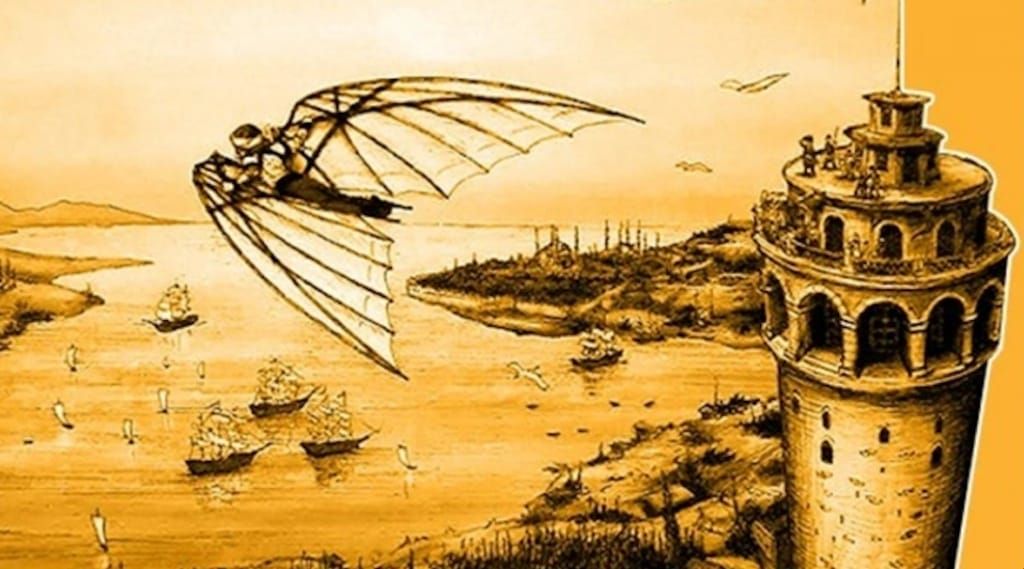
Few stories associated with Galata Tower are as widely known — and as widely debated — as the account of Hezarfen Ahmed Çelebi.
Often described as an early aviator who flew across the Bosphorus in the 17th century, Hezarfen Ahmed Çelebi occupies a unique place between documented history and cultural legend. Understanding his story requires separating what is recorded, what is plausible, and what later imagination has amplified.
The Primary Source: Evliya Çelebi
The only historical source that explicitly describes Hezarfen Ahmed Çelebi’s flight is Evliya Çelebi, the 17th-century Ottoman traveler and writer best known for his monumental work, Seyahatname (Book of Travels).
According to Evliya Çelebi, Hezarfen Ahmed Çelebi conducted experiments in flight using artificial wings and ultimately launched himself from the top of Galata Tower, gliding across the Bosphorus to Üsküdar.
Evliya Çelebi’s account is vivid and confident — but it stands alone.
No other contemporary Ottoman chronicles, court records, or administrative documents confirm the event.
Evaluating Historical Reliability
Modern historians approach Evliya Çelebi’s writings with careful consideration. While his work contains valuable geographical, cultural, and social observations, it also blends factual reporting with storytelling, exaggeration, and anecdotal material.
This does not render his account meaningless — but it does require contextual reading.
Key points often highlighted by scholars include:
- The absence of corroborating sources
- The technical challenges of controlled human flight in the 17th century
- Evliya Çelebi’s known narrative style, which favored dramatic detail
As a result, most academic interpretations classify the story as unverified, rather than proven fact.
Scientific Curiosity in the Ottoman World
Importantly, the legend of Hezarfen Ahmed Çelebi did not emerge in a vacuum.
The Ottoman intellectual environment of the 16th and 17th centuries included:
- Interest in mechanics and natural sciences
- Observations of birds and aerodynamics
- Translations of earlier Islamic and European scientific works
Figures experimenting with physical phenomena were not unheard of. The idea that an individual might attempt gliding experiments from an elevated structure is not inherently implausible, even if the details remain uncertain.
In this sense, Hezarfen Ahmed Çelebi represents a broader spirit of experimentation rather than a confirmed technological breakthrough.
Galata Tower as a Symbolic Launch Point
Regardless of historical verification, the association between Hezarfen Ahmed Çelebi and Galata Tower is significant.
Galata Tower was:
- One of the tallest structures in Istanbul
- A known observation and watchtower
- A site associated with surveillance, vision, and oversight
Its role as a symbolic starting point for a flight narrative reinforces the tower’s image as a place where ambition meets elevation.
Over time, the story and the structure became inseparable in popular memory.
Myth, Memory, and Cultural Meaning
From a historical perspective, the enduring value of the Hezarfen story lies not in its technical accuracy, but in its cultural resonance.
The legend reflects:
- Admiration for innovation
- Curiosity about human limits
- A narrative of daring exploration
These themes align closely with Istanbul’s identity as a city shaped by encounters between ideas, cultures, and technologies.
As such, Hezarfen Ahmed Çelebi functions as a symbolic figure, representing imagination rather than documented aviation history.
Modern Interpretations and Popular Culture
In modern times, the story of Hezarfen Ahmed Çelebi has been embraced in literature, education, and media. While popular representations often present the flight as historical fact, scholarly discussions remain more restrained.
This divergence highlights an important distinction:
- Popular history seeks inspiration
- Academic history seeks verification
Both perspectives contribute to the tower’s narrative, but they serve different purposes.
Why the Hezarfen Story Still Matters
For visitors today, the story of Hezarfen Ahmed Çelebi adds an intangible layer to the Galata Tower experience.
It encourages reflection on:
- The human desire to transcend limits
- The role of imagination in scientific progress
- The ways cities preserve stories alongside structures
Even without definitive proof, the legend has become part of Istanbul’s collective memory — and Galata Tower remains its physical anchor.
A Balanced Historical Perspective
An authority-based approach does not require choosing between belief and dismissal.
Instead, it recognizes that:
- The story cannot be fully verified
- The attempt itself is historically plausible
- Its cultural impact is undeniable
In this balance between skepticism and appreciation, the figure of Hezarfen Ahmed Çelebi continues to occupy a meaningful place in the layered history of Galata Tower.
Subscribe to newsletter
Subscribe to my newsletter to get the latest updates and news